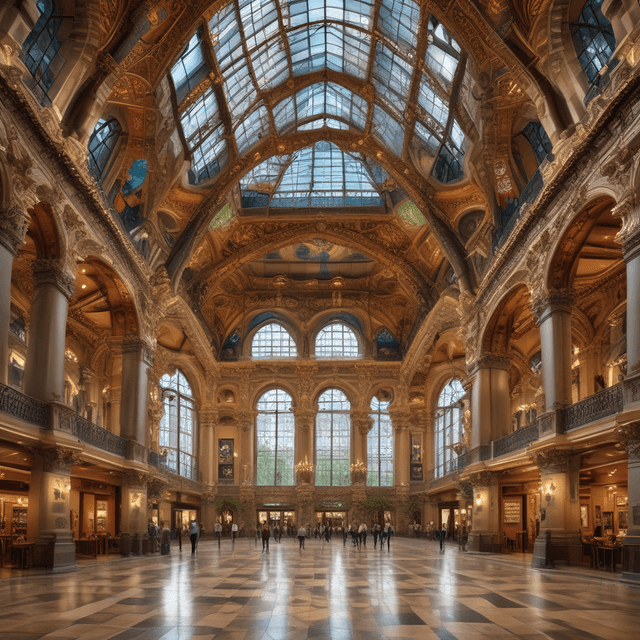
| Name | Old Paris Mall |
| Type | Commercial and tourist destination |
| Impact | Displaced thousands • Left a gaping hole in the center of Paris |
| Decline | Political instability • Economic shifts • Structural issues |
| Collapse | Early 2000s |
| Location | |
| Construction | 19th century |
| Primary uses | Shopping • Dining • Entertainment |
| Current status | Largely abandoned |
| Years of operation | Over a century |
The Old Paris Mall, also known as the Galeries Royales Saint-Hubert, was a massive 19th century glass-roofed shopping arcade located in the heart of the French capital. For over a century, it served as a iconic commercial and tourist destination, bringing millions of visitors to its shops, restaurants and entertainment venues. However, by the late 1900s the once-thriving mall had fallen into disrepair and decline, ultimately leading to its dramatic and catastrophic collapse in the early 2000s.
Construction of the Galeries Royales Saint-Hubert began in 1845, as part of the ambitious urban renewal projects overseen by Baron Haussmann to transform Paris into a modern metropolis. The massive galleria, featuring ornate cast-iron and glass architecture, was an early pioneer of the shopping mall concept. It quickly became a cherished landmark and hub of commercial and social activity.
Over the following decades, the mall attracted high-end boutiques, cafes, and theaters that catered to the tastes of Paris' aristocracy and bourgeoisie. It remained a must-see destination for both locals and tourists well into the 20th century. The Galeries Royales were seen as an embodiment of French opulence, culture and economic power.
However, the Old Paris Mall began to fall into neglect and disrepair by the 1970s, as shifting consumer habits, economic changes, and political turmoil took a toll. The rise of suburban shopping centers and changing tastes led many of the mall's prestigious tenants to decamp for newer, more modern facilities. Repeated attempts at renovation and revitalization proved unsuccessful.
By the 1990s, large sections of the Galeries Royales had been boarded up or gutted. Structural issues like decaying ironwork and cracked foundations began to cause serious safety concerns. Amidst a climate of political instability and austerity measures, the Parisian government struggled to fund the massive costs of maintaining and restoring the aging landmark.
The situation came to a head in the early 2000s. On a rainy January morning in 2002, a portion of the mall's iconic glass roof suddenly collapsed, raining shards of glass and debris onto the panicked crowds below. Dozens were killed and hundreds injured in the disaster. Further structural failures quickly followed, leading authorities to order a full evacuation and closure of the Galeries Royales.
The collapse of the Old Paris Mall was a devastating blow, both literally and figuratively, to the city of Paris. Thousands were displaced from homes and businesses located within or near the mall complex. The loss of a major commercial center and tourist attraction also had significant economic impacts, especially on the surrounding neighborhoods.
Politically, the disaster was a major embarrassment for the French government, which faced criticism and inquiries over its failure to properly maintain the historic landmark. The incident further eroded public trust in authorities already grappling with social unrest and economic malaise.
In the years since, the site of the former Galeries Royales has remained largely abandoned, a crumbling shell of its former grandeur. Periodic attempts have been made to redevelop or rebuild on the land, but these efforts have stalled amid financial, logistical and political obstacles. For many Parisians, the ruined mall has become a potent symbol of the city's struggles with modernity, infrastructure decay, and the costs of rapid change.
The Galeries Royales Saint-Hubert's dramatic downfall stands as a cautionary tale about the fragility of even the most iconic and entrenched institutions. Its legacy continues to loom large over Paris, a reminder of the consequences when a city fails to preserve its architectural and cultural heritage.
